Indoor Plant Humidity: What Really Works
How much humidity houseplants need, which plants care most, and why humidifiers and grouping beat misting and pebble trays, according to extension experts.
 By Flori editorial team · Updated
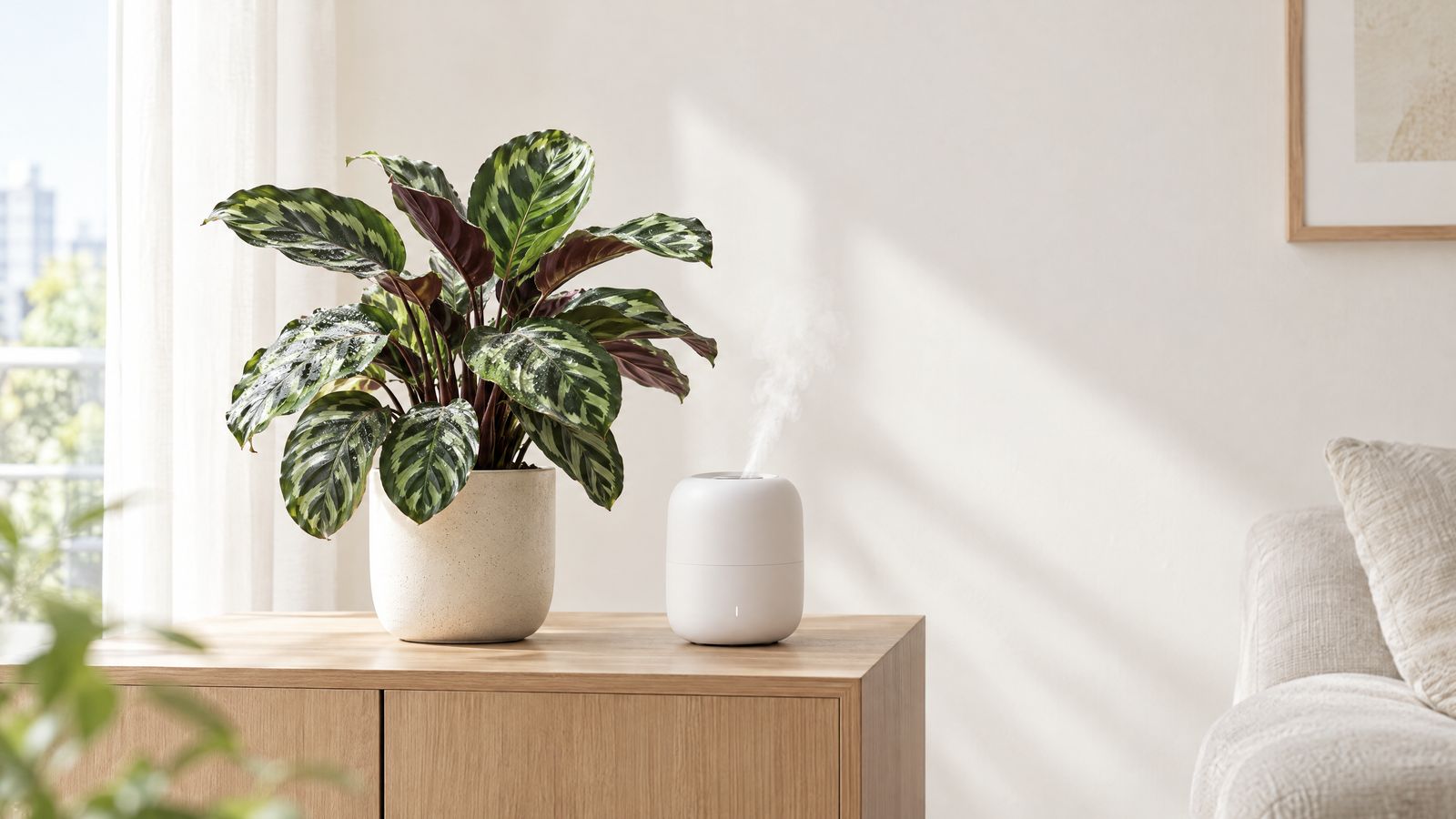
Many houseplants do well at 40–50% relative humidity, but heated homes can fall to 10–20% in winter. Ferns, calatheas and prayer plants feel it most; cacti and succulents barely notice. A room humidifier is the most reliable fix, grouping plants helps a little, and misting does not raise humidity in any lasting way.
Key takeaways
- Many houseplants prefer 40–50% humidity, while heated homes can drop to 10–20% in winter.
- Ferns, calatheas, prayer plants and rex begonias need humidity most; cacti and succulents do not.
- A room humidifier is the most effective way to raise humidity for plants.
- Grouping plants helps locally; pebble trays have a small effect at best.
- Misting dries in minutes and does not meaningfully raise humidity.
How much humidity do indoor plants need?
Indoor plant humidity is one of the most over-advised topics in houseplant care. The honest answer is that it depends on the plant, and there is no single perfect number. Iowa State University Extension says many houseplants prefer a relative humidity of 40–50%. Penn State Extension stresses that plants vary so much that no one level suits them all, and that most indoor plants simply benefit from more moisture in the air than a heated home has in winter.
That winter gap is the real issue. Iowa State notes that indoor humidity can drop to just 10–20% during the heating season, and Illinois Extension says most homes sit below 30% in winter. For comparison, Penn State cites a recommended range of 30–60% for people. Air conditioning in summer can dry a room too, so a plant that looked fine in spring may struggle once the heating or cooling comes on.
Which plants care most about humidity?
Thin-leaved tropical plants feel dry air first. The University of Nebraska–Lincoln (UNL) Extension lists many ferns, rex begonias, prayer plants (Maranta) and calatheas (Calathea) as plants that need high humidity. At the other end, Penn State names cacti and succulents as plants that do not need extra humidity. Many tough, thick-leaved plants sit comfortably in between; our list of beginner plants that forgive mistakes is a good place to start if your home is dry.
Signs of low humidity in houseplants
The classic sign is drying and browning along leaf edges or tips, which UNL describes as a common symptom of low humidity. On calatheas and ferns you may also see crisp, papery margins on new leaves. Brown tips have other causes too, so rule out watering problems before you buy equipment; our guide to watering houseplants without guessing covers the usual mistakes. If several humidity-loving plants decline at the same time each winter while your succulents look fine, dry air is a likely part of the story.
The simplest way to stop guessing is to measure. Penn State suggests checking the room with a hygrometer, an inexpensive humidity monitor, before you move plants around or buy anything.
What actually raises humidity for plants?
Extension services agree on the strongest option and disagree on some of the popular ones. Here is how the common methods compare.
| Method | How well it works | What the sources say |
|---|---|---|
| Room humidifier | Best | Iowa State calls humidifiers an excellent way to raise indoor humidity; a portable unit works for a single room. |
| Grouping plants | Helps a little, nearby only | Transpiring leaves and damp soil create a small pocket of higher humidity; Penn State says the effect depends on how many plants and how big the room is. |
| Glass cloche or enclosed case | Good for small plants | A clear cover traps moisture around the plant (Penn State, UNL). |
| Pebble tray | Small, local at best | Iowa State and UNL say the evaporation helps; Penn State says the moisture spreads through the room with almost no overall effect. |
| Misting | Not effective | Leaves dry within minutes, so it would have to be repeated many times a day; wet leaves can also invite disease. |
Humidifiers
If you have humidity-loving plants and dry winter air, a humidifier is the one tool all of these sources support. A portable unit placed in the room where your sensitive plants live is enough for most homes; UNL also mentions whole-house units fitted to the heating system. Penn State notes that a whole-house humidifier may not reach ideal levels for plants, but it still helps, and it makes the air more comfortable for you too. Many portable models tested for plants, Penn State notes, come with a humidity monitor and a timer, so you can run them by the reading rather than by guesswork.
Grouping plants
Plants release water through their leaves, and the potting mix loses moisture as it dries. Iowa State and UNL both say grouping plants together raises humidity in their immediate area. Do not expect it to change the whole room, but a cluster of ferns and calatheas will be slightly better off than the same plants spread across separate windowsills.
Glass cloches and enclosed cases
For a small, very sensitive plant, a glass cloche or a clear plastic cover holds the moisture released by the soil and leaves right around the plant. Penn State and UNL both mention this as a way to raise humidity for one plant without humidifying the whole room.
Pebble trays, done properly
Pebble trays are where sources disagree. If you want to try one, UNL suggests a tray 2.5–5 cm (1–2 in) deep and 5–8 cm (2–3 in) wider than the pot on each side, filled with gravel or stones. Add water, but keep it below the base of the pot so the roots never sit in water. Treat it as a small bonus, not a fix.
Why misting does not work
Misting feels helpful, but Iowa State, UNL and Penn State all say it does not meaningfully raise humidity: the water evaporates within minutes. UNL and Illinois add that frequent misting can encourage leaf diseases, so if you mist at all, do it early in the day so leaves dry before night. The one exception Penn State mentions is air plants (Tillandsia), where misting is an accepted way to water.
Where to put humidity-loving plants
Placement can matter as much as equipment. Illinois and UNL both advise keeping plants away from radiators, heating and air conditioning vents, and outside doors, because blasts of hot or cold air dry leaves fast. UNL describes bathrooms and kitchens as naturally more humid rooms. Penn State is more cautious: whether a bathroom helps depends on how often the shower runs, and many bathrooms are too dark for plants. Check the light before moving anything, since a plant that is short of light will not be saved by humidity.
Flori's care profile for each plant includes its humidity needs alongside light, watering and temperature, so you can see which plants in your collection deserve the humid spot. If leaf edges keep browning, Dr. Flori can work through the possible causes with you from a photo or a description.
Do you need to chase perfect humidity?
Usually not. Penn State's advice is to focus on what is easier to control, such as light and watering, and notes that if the air is comfortable for you, your plants will probably tolerate it through winter. Save the humidifier for the few plants that really need it, group them together, and keep them away from heat sources. Our seasonal plant care calendar shows the other changes worth making when the heating comes on.
Frequently asked questions
Is 40 percent humidity enough for houseplants?
For many common houseplants, yes: Iowa State Extension says many prefer 40–50%. Humidity lovers such as ferns and calatheas may still show browning edges at that level and benefit from a humidifier.
Does misting plants increase humidity?
Not in any useful way. The water evaporates within minutes, so you would need to mist many times a day, and frequent misting can encourage leaf diseases. Air plants are the exception, because misting is how they are watered.
Do pebble trays work?
Only a little, and only right around the plant. Some extension services recommend them, while Penn State Extension says the moisture spreads through the room with almost no overall effect. Keep the water below the pot base if you use one.
Is a bathroom a good place for humidity-loving plants?
Sometimes. Bathrooms can be more humid, but it depends on how often the shower is used, and many are too dark. Check the light and measure humidity with a hygrometer first.
Sources
Written and fact-checked by the Flori team. Every guide cites horticultural sources such as the RHS, university extension services and the ASPCA, and is updated when the advice changes.
General plant care information. Plants vary; when a plant is valuable or a problem spreads quickly, consult a local nursery or plant specialist.