Spider Mites on Houseplants: Signs and Treatment
Spider mites leave pale specks, bronzed leaves and fine webbing. How to confirm them with a white paper test and treat them, least toxic first.
 By Flori editorial team · Updated
Spider mites show up as tiny pale specks on leaves, then bronzing, fine webbing and leaf drop, mostly in warm, dry rooms. Confirm them by tapping a leaf over white paper. Isolate the plant, cut off the worst leaves, wash or wipe the foliage every week or two, raise humidity, and use horticultural oil if needed, following the label.
Key takeaways
- Pale specks on leaves, a dull bronze or grey cast and fine webbing under leaves are the classic signs.
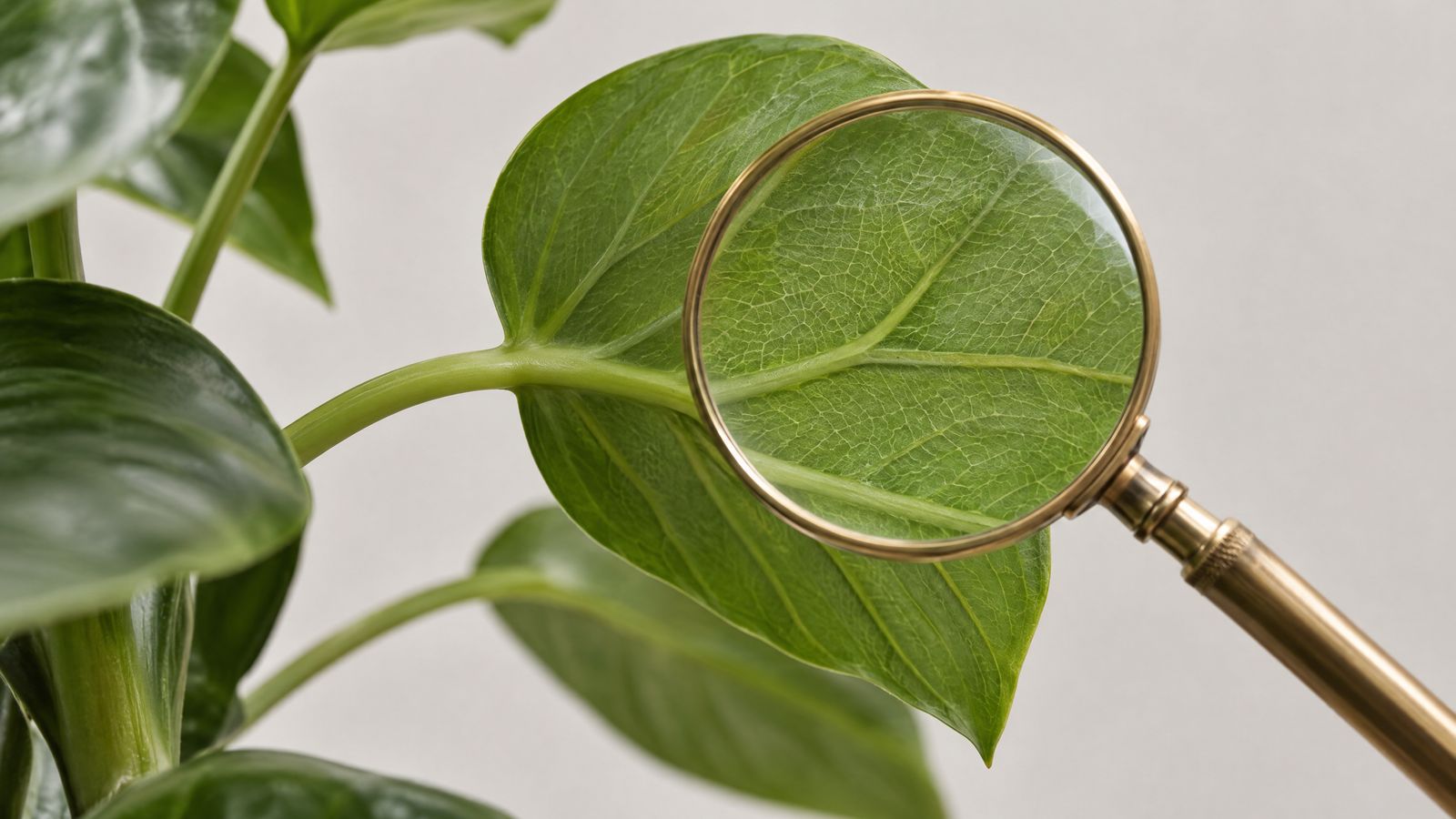
- Tap a leaf over white paper: moving dots are mites. A 10x hand lens shows them clearly.
- Dry air and thirsty plants favour mites; in warm conditions a new generation can appear in about a week.
- Wash or wipe leaves, remove the worst ones and repeat; horticultural oil is the most effective home spray.
- Avoid broad-spectrum insecticides, which can make spider mite outbreaks worse, and always follow the label.
How do you know if a houseplant has spider mites?
Spider mites on houseplants are easy to miss until the damage is obvious, because the mites themselves are smaller than a full stop. The first sign is usually the leaves: tiny pale specks, then a dull, dusty or bronze look, and in bad cases fine webbing between leaves and stems. This guide shows how to confirm spider mites in two minutes with a sheet of white paper, gives a sign → cause → first step table so you do not mistake them for thrips or dust, and walks through treatment from the gentlest step up, with the label rules that matter.
What do spider mites look like?
Spider mites are not insects but tiny arachnids, relatives of spiders and ticks. UC IPM describes adults as less than 1.3 mm (1/20 in) long, with eight legs and an oval body. To the naked eye they look like tiny moving dots. The species found most often on houseplants is the twospotted spider mite (Tetranychus urticae); Colorado State Extension notes that mites can be red, brown, yellow or green, and adult female twospotted mites carry a dark blotch on each side of the body.
They live mostly on the undersides of leaves, where a single colony can hold hundreds of individuals. Look there for the mites, their round eggs near the leaf veins, empty egg shells and webbing.
Spider mite signs and what they mean
| What you see | Likely cause | What to do first |
|---|---|---|
| Tiny pale or white specks on the upper side of leaves | Stippling: mites sucking out individual leaf cells from below | Turn the leaf over and do the white paper test |
| Leaves look dusty, grey or bronzed | Heavy feeding over several weeks | Isolate the plant and wash the foliage |
| Fine, silky webbing at leaf joints and under leaves | A high population; webbing is what separates spider mites from most other tiny pests | Cut off the worst leaves, bag them, then wash |
| Leaves yellowing or turning reddish, then dropping | Severe, sustained feeding | Trim heavily infested growth; discard a plant that is mostly webbed |
| Specks but no mites on paper, no webbing | Possibly old damage, or another cause such as thrips | Check again in a few days with a hand lens |
The white paper test
Hold a sheet of white paper under a few suspect leaves and tap or shake them. UC IPM recommends this because disturbed mites move quickly and show up as walking specks against the white. A 10x hand lens makes them easy to see. Damage often appears before you notice the mites, so check plants near the one with symptoms too.
Why do spider mites love dry indoor air?
Colorado State Extension explains that dry conditions strongly favour all spider mites: in low humidity they can get rid of excess water more easily, so they feed more. Their natural enemies, by contrast, prefer humid air. Thirsty plants are also more attractive, because drought stress changes the plant chemistry in the mites' favour, and UC IPM notes that hot, dusty conditions help them too. That is why outbreaks often start in winter near a radiator or in summer on a sunny, dry windowsill.
They also breed fast. In warm conditions a new generation can develop in less than a week (UC IPM), and Colorado State says a mature female may lay about a dozen eggs a day for a couple of weeks. One treatment never finishes the job.
How to get rid of spider mites on indoor plants
Work through these steps in order and only go as far as you need.
- Isolate the plant. Move it away from other plants so mites cannot walk or drift across.
- Remove the worst growth. Colorado State advises trimming heavily infested leaves, bagging them and throwing them away. A plant that is covered in webbing is often better discarded.
- Wash or wipe the leaves. Rinse small plants under the shower or a strong spray of lukewarm water, aiming at the leaf undersides and covering the soil. Wipe large leaves with a damp cloth. Repeat every one to two weeks while mites persist (Colorado State). Washing also breaks the webbing that protects them.
- Fix the conditions. Water consistently so the plant is not drought stressed, keep it away from heaters, and raise humidity. Colorado State lists washing and higher humidity as the most effective non-chemical controls for houseplants; our indoor plant humidity guide explains which methods actually raise it.
- Spray if numbers stay high. Horticultural oil is described by Colorado State as perhaps the most effective miticide for home use. Insecticidal soap is also used; UC IPM lists soap and oil as the preferred options, but Colorado State finds soap only marginally effective against twospotted spider mites and poor where webbing blocks it, so oil is the better first choice. Both work only on mites they actually coat, so soak the leaf undersides.
- Repeat. Most sprays do not kill eggs, so a second treatment is usually needed; check the label for the interval.
With any spray, test it on a few leaves first and wait a day or two for damage. UC IPM warns not to spray water-stressed plants or when temperatures are above 32 °C (90 °F). Check that your plant and spider mites are on the label, and follow the label for dilution, timing and safety. Predatory mites sold for biological control have worked on indoor plants (Colorado State), which can suit a large collection or a conservatory.
What not to use on spider mites
Broad-spectrum insecticides are a trap. UC IPM notes that carbaryl, some organophosphates and some pyrethroids can trigger mite outbreaks, and Colorado State says carbaryl devastates spider mite natural enemies. Products that do not kill mites still kill whatever was eating them. If a few plants are badly affected, removing them is often wiser than escalating to stronger chemicals.
How to keep spider mites from coming back
- Quarantine new plants. Colorado State recommends keeping new plants in a separate area for at least three weeks and inspecting them before they join the others.
- Check leaf undersides weekly, especially in dry, heated rooms and in hot summer weather. Our natural pest prevention guide has a simple weekly routine.
- Keep plants evenly watered and dust-free. Wiping leaves now and then removes dust and stray mites at the same time.
Not sure whether the specks are spider mites, thrips or something else? Flori's Lab tools for pest analysis and the Dr. Flori chat can work from a close photo of the leaf underside, and Plant Hospital keeps the plant on a follow-up plan with reminders to repeat the washing. If leaves are already dropping, see plant leaves falling off for the other causes to rule out, and aphids on plants if you also find soft-bodied insects on new growth.
Frequently asked questions
Can spider mites spread to other houseplants?
Yes. They crawl between touching leaves and travel on hands, tools and air currents. Isolate an infested plant, check its neighbours with the white paper test and quarantine new plants for at least three weeks.
Does misting get rid of spider mites?
Misting alone will not clear an infestation. Washing the leaves, especially the undersides, removes mites and webbing, and keeping humidity higher makes conditions worse for them. Repeat every one to two weeks.
Is insecticidal soap or horticultural oil better for spider mites?
Colorado State Extension rates horticultural oil as the most effective home miticide and soap as only marginally effective against twospotted spider mites. Whatever you use, check the label lists your plant and follow it.
Can a plant recover from spider mites?
Usually, if you act before most leaves are damaged. Damaged leaves will not turn green again, but new growth will be clean once the mites are gone. A plant covered in webbing is often better discarded.
Sources
Written and fact-checked by the Flori team. Every guide cites horticultural sources such as the RHS, university extension services and the ASPCA, and is updated when the advice changes.
General plant care information. Plants vary; when a plant is valuable or a problem spreads quickly, consult a local nursery or plant specialist.