Christmas, Thanksgiving or Easter Cactus: Which Is Yours?
Tell Christmas, Thanksgiving and Easter cactus apart by leaf edge and anther colour, plus how to make them bloom and why they are safe for pets.
 By Flori editorial team · Updated
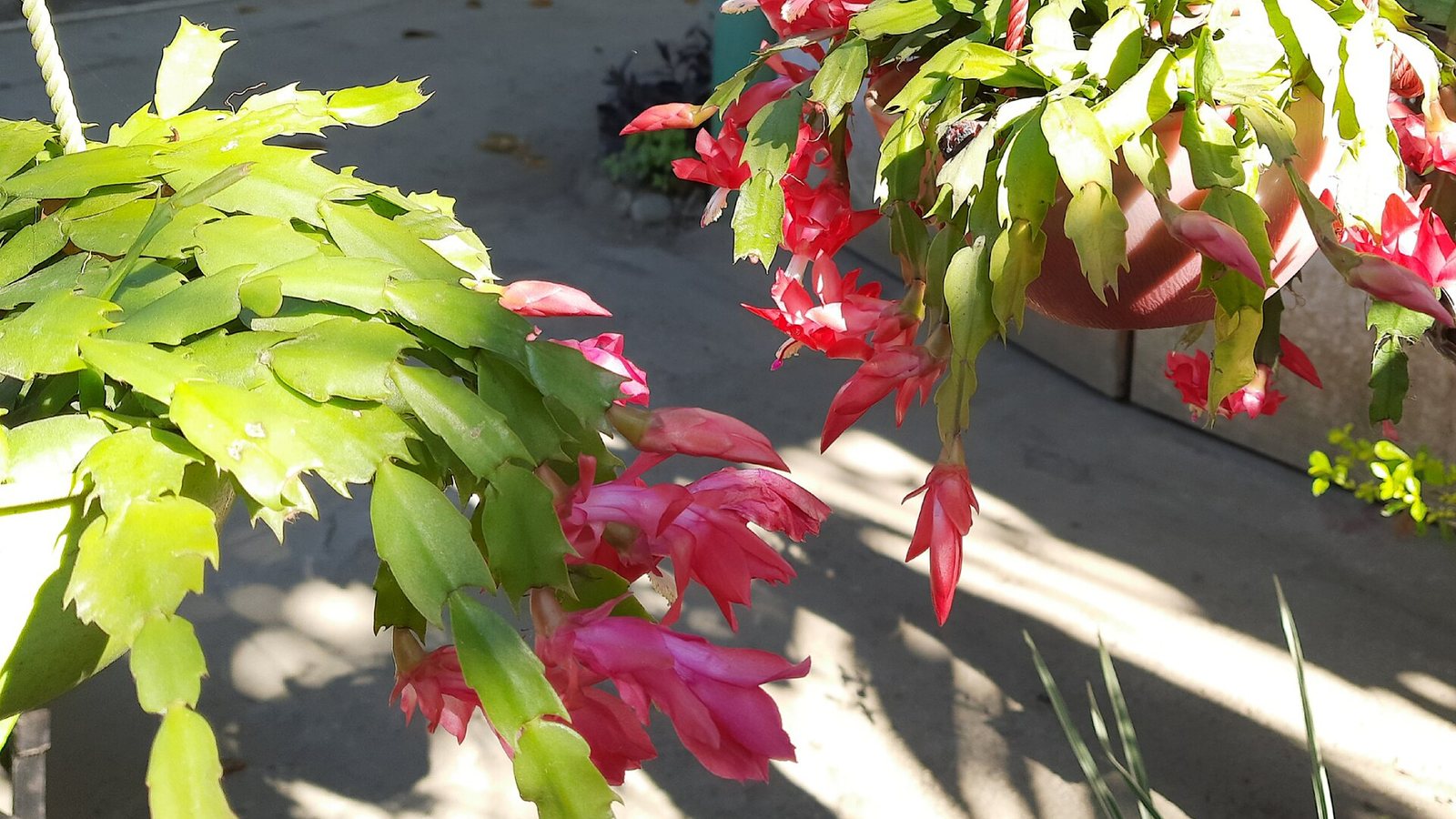
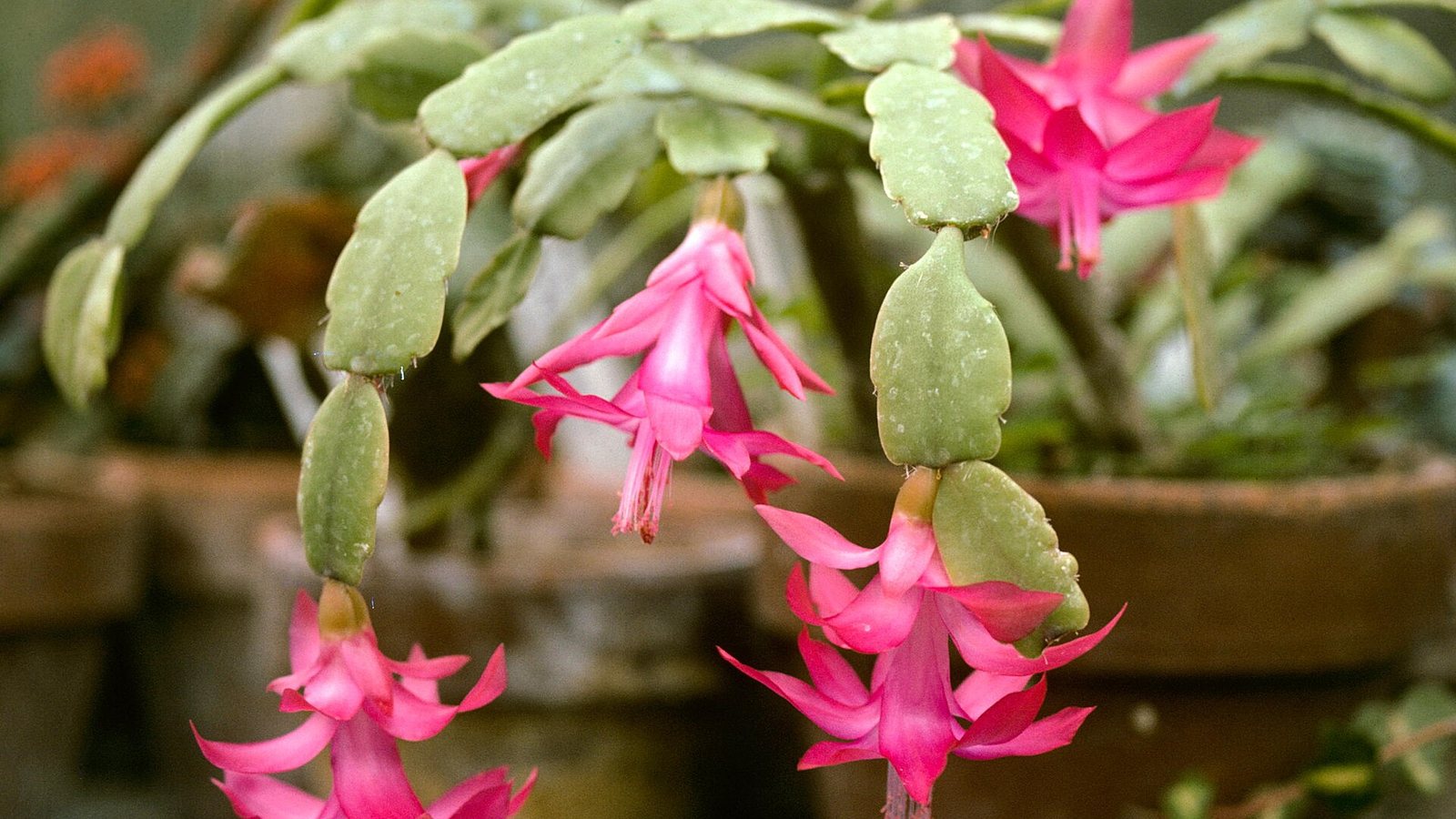 Photo: WayneRay · Public domain
Check the leaf segments. Thanksgiving cactus has sharp saw-like teeth, Christmas cactus has rounded scalloped edges, and Easter cactus is very rounded with tiny bristles. Bloom time is only a hint. All three are Schlumbergera relatives and, per the ASPCA, the Christmas cactus is non-toxic to cats and dogs. To bloom they need long dark nights and cool air.
Key takeaways
- Segment edges are the most reliable clue: pointed teeth mean Thanksgiving cactus, scalloped edges mean Christmas cactus, very rounded with bristles means Easter cactus.
- Many shop-bought Christmas cacti are really Thanksgiving cacti, which flower about a month earlier.
- To bloom, give 13 to 16 hours of darkness and cool nights of 13–16 °C (55–60 °F) for 6 to 8 weeks; buds appear in 3 to 4 weeks.
- Once buds form, keep the plant steady and away from drafts and heat sources.
- The ASPCA lists the Christmas cactus as non-toxic to cats and dogs.
On this page7
- Is it a Christmas, Thanksgiving or Easter cactus?
- How do you tell the three holiday cacti apart?
- Why is my holiday cactus blooming at the wrong time?
- How do you get a holiday cactus to bloom again?
- How much light and water does a holiday cactus need?
- Are Christmas, Thanksgiving and Easter cacti safe for cats and dogs?
- What if you are in the southern hemisphere?
Is it a Christmas, Thanksgiving or Easter cactus?
Many "Christmas cacti" sold in shops are not Christmas cacti. All three holiday cacti are close relatives in the genus Schlumbergera (botanists have not fully settled the naming, and the Easter cactus is also filed as Rhipsalidopsis gaertneri), and they are routinely mixed up. This guide shows how to tell yours apart by the shape of its leaf segments, why it flowers when it does, and how to get it to bloom again. It also covers pet safety: the ASPCA lists the Christmas cactus as safe for cats and dogs.
How do you tell the three holiday cacti apart?
The flat, jointed "leaves" are really stems (cladodes). NC State Extension calls their edge shape the most reliable identifier, with bloom time only one indicator. Check a fresh segment in good light.
| Thanksgiving cactus | Christmas cactus | Easter cactus | |
|---|---|---|---|
| Latin name | Schlumbergera truncata | Schlumbergera × buckleyi | Schlumbergera gaertneri |
| Segment edges | Sharp saw-like teeth, about 2 to 4 per side | Rounded, scalloped margins | Very rounded, with small bristles on top of the segments |
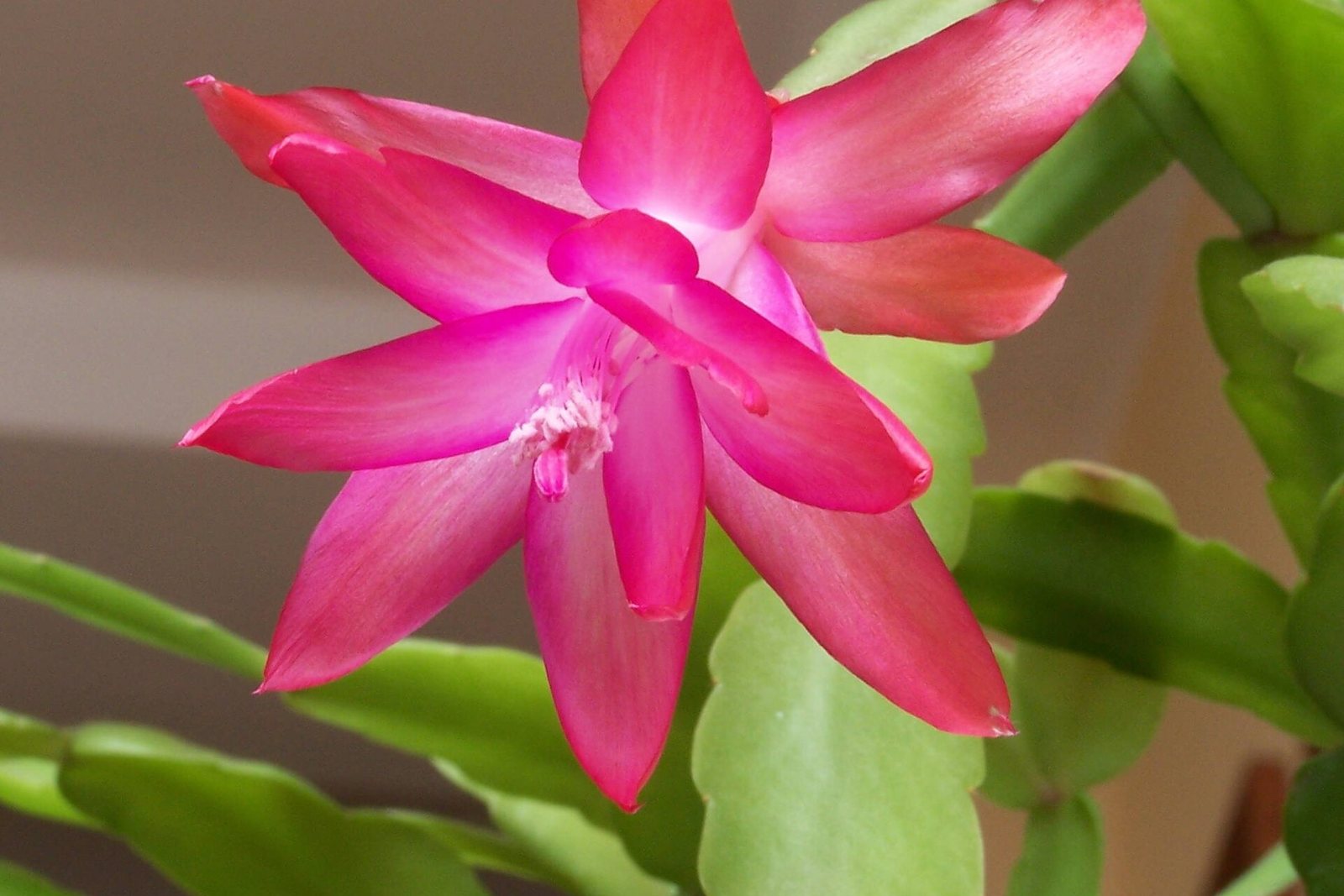
| Anthers (pollen heads) | Yellow | Purplish brown | Not covered by our sources |
| Flowers | Late autumn | About a month later | Spring, as its name suggests |
Sources: NC State Extension Gardener, University of Georgia Extension and UF/IFAS. If your plant has pointed teeth and flowered in November, it is a Thanksgiving cactus, whatever the label said. For the wider cactus family, see cactus types and their names.
Why is my holiday cactus blooming at the wrong time?
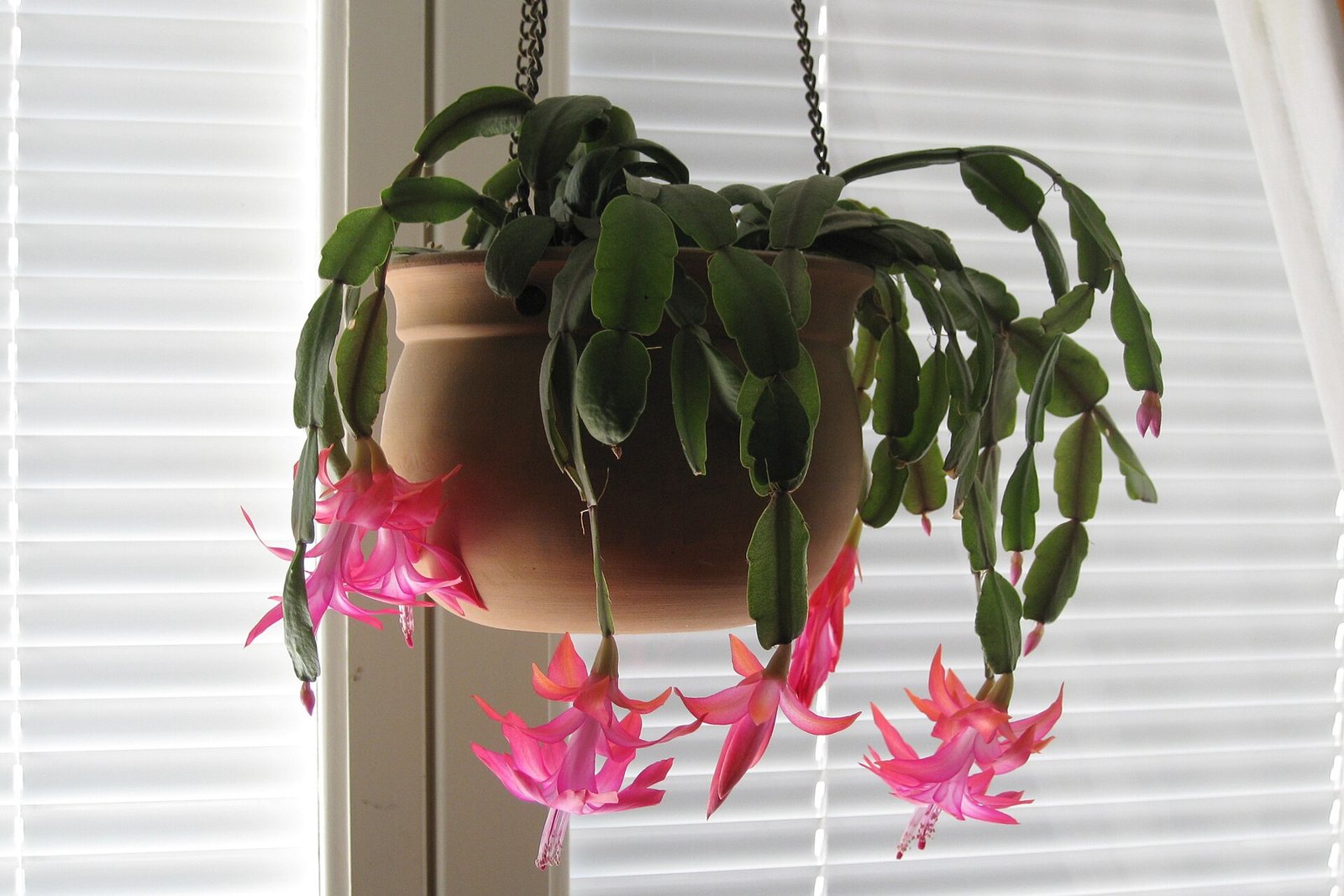
The common names are only a hint. University of Georgia Extension notes that Thanksgiving cacti start flowering in late autumn and Christmas cacti around a month later, so a plant that opens its first flowers in November is probably the first kind. The cue the plants respond to is the length of the night and its temperature, not the date on the calendar, so a cool, dark room can bring flowers earlier and a warm, lit one can hold them back.
How do you get a holiday cactus to bloom again?
UF/IFAS explains that shorter days and cooler nights trigger flowers, and that the plant needs at least twelve hours of darkness. University of Georgia Extension gives more detail for the autumn setup:
- Darkness. Aim for roughly 13 to 16 hours of uninterrupted darkness a night for 6 to 8 weeks. The numbers in the Georgia page vary a little (13 to 16 hours for about eight weeks in one place, 14 or more for at least six in another), so treat this as a range. Even 2 hours of light at night, from a lamp or a TV, can stop buds forming.
- Cool nights. Night temperatures of 13–16 °C (55–60 °F) are ideal. Nights of 10–15 °C (50–59 °F) set buds whatever the day length, but growth slows and buds can drop at 10 °C (50 °F).
- Buds appear in 3 to 4 weeks. Once you see them, keep the pot steady and avoid sudden changes.
- Keep it below 32 °C (90 °F) after buds set, and never leave it outdoors in temperatures under 10 °C (50 °F).
A spare room, a porch that stays above 10 °C or a bright window that is never lit at night can all work. UF/IFAS also advises keeping the plant away from drafts and heat sources such as vents, fireplaces and televisions.
How much light and water does a holiday cactus need?
These are rainforest plants, not desert cacti, which is why they want more water than a typical cactus. The same care suits all three.
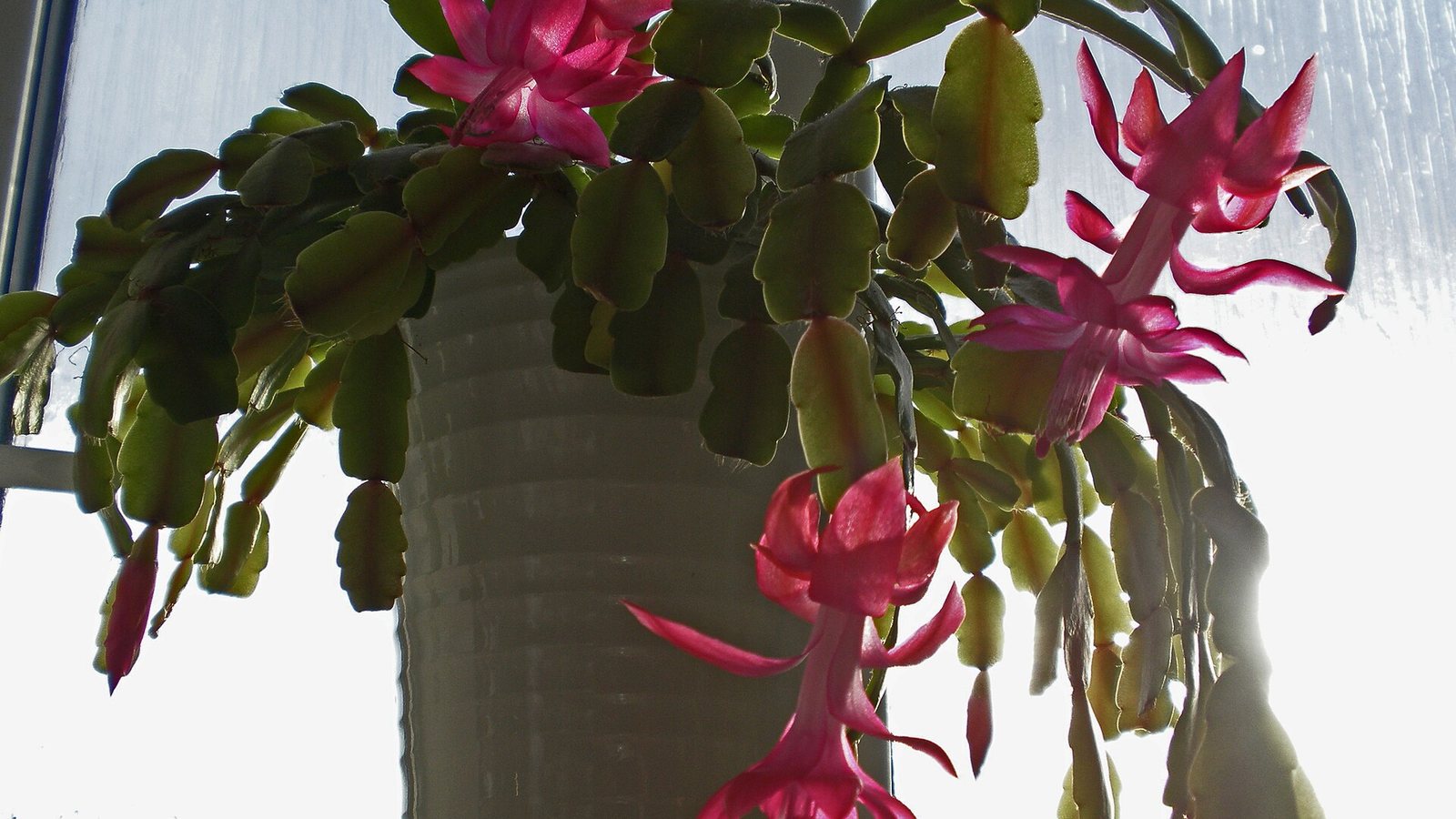
- Light. Bright, indirect light, within about 2 m (6 ft) of a south-, east- or west-facing window in the northern hemisphere (UF/IFAS). University of Georgia Extension adds that bright summer sun makes plants pale.
- Water. Water when the upper 2.5 cm (1 in) of mix is dry (UF/IFAS). Once buds have formed, keep the mix evenly moist and never let water stand in the saucer. Overwatering rots stems and roots; for the dry-out schedule see how often to water succulents and cacti.
- Pot and mix. A well-drained mix. They flower best slightly pot-bound and need repotting only about every three years, in spring.
- Growing season. Georgia Extension suggests 21–27 °C (70–80 °F) from spring to early autumn, and half-strength fertiliser monthly from late winter through summer, stopped in late summer.
Segments that shrivel and go limp usually point to watering; use the overwatering versus underwatering guide to read the signs. Spare segments can be rooted as cuttings in May or June in the northern hemisphere, and the step-by-step is in how to propagate succulents and cacti.
Are Christmas, Thanksgiving and Easter cacti safe for cats and dogs?
The ASPCA lists Christmas cactus (Schlumbergera bridgesii, also known as Easter cactus) as non-toxic to dogs, cats and horses. That makes it a festive choice when pets share the house, unlike poinsettia or amaryllis; our Christmas plants toxic to pets guide covers those. Non-toxic is not the same as a snack, since any plant can upset a stomach if a lot is eaten, and the ASPCA entry covers only the plant it names, so check other "cacti" before you bring them home. If your pet eats something unusual and seems unwell, call your vet or the ASPCA Animal Poison Control line.
What if you are in the southern hemisphere?
The plants read night length and temperature, not the month, so the same rules apply, just shifted by six months. In Sydney, Cape Town or Buenos Aires, Christmas falls in early summer, when nights are short and warm, so a plant will not flower for the holiday unless you give it the long, cool nights described above. If you are in the northern hemisphere, start in late September so flowers open for the holidays.
Not sure which one you own? A photo of the plant in Flori suggests a name and shows its care profile, but the segment-edge check above is the quickest test.
Frequently asked questions
How can I tell a Christmas cactus from a Thanksgiving cactus?
Look at the segment edges. Thanksgiving cactus has sharp saw-toothed projections, Christmas cactus has rounded scalloped margins. Anther colour also differs: yellow on Thanksgiving, purplish brown on Christmas.
Why did my Christmas cactus bloom in November?
It is probably a Thanksgiving cactus, which flowers in late autumn, about a month before a true Christmas cactus. Cooler nights and longer darkness also bring flowering forward.
How do I make a holiday cactus bloom?
Give about 13 to 16 hours of uninterrupted darkness and cool nights of 13–16 °C (55–60 °F) for 6 to 8 weeks. Even brief light at night can stop buds forming.
Is a Christmas cactus poisonous to cats and dogs?
The ASPCA lists Christmas cactus (Schlumbergera bridgesii) as non-toxic to dogs, cats and horses. Call your vet if a pet eats a lot and seems unwell.
The best Christmas and New Year gift plants, with the room temperature each needs and which are safe for cats and dogs, for both hemispheres.
Sources
Written and fact-checked by the Flori team. Every guide cites horticultural sources such as the RHS, university extension services and the ASPCA, and is updated when the advice changes. How we write our guides
General plant care information. Plants vary; when a plant is valuable or a problem spreads quickly, consult a local nursery or plant specialist.